Executive Summary
The global semiconductor industry generated approximately $630 billion in revenue in 2024 and is projected to reach $701 billion in 2025, placing it on a trajectory to surpass $1 trillion in annual sales by the end of this decade. Semiconductors are the foundational building blocks of the modern economy, embedded in virtually every electronic device from smartphones and automobiles to data centers and military systems.
The industry is distinguished by several structural characteristics that set it apart from most other sectors. It is intensely cyclical, with boom-bust patterns driven by the interplay of capacity investment cycles and inventory dynamics across a complex global supply chain. It is extraordinarily capital-intensive, with a single leading-edge fabrication facility costing $20 billion or more to construct. It is also one of the most R&D-intensive industries in the world, with U.S.-headquartered firms investing $62.7 billion in research and development in 2024 alone, representing 17.7 percent of revenue — second only to pharmaceuticals.
The competitive landscape has evolved dramatically. What was once dominated by vertically integrated device manufacturers (IDMs) has fragmented into a specialized ecosystem of fabless designers, pure-play foundries, equipment suppliers, electronic design automation (EDA) vendors, and outsourced assembly and test (OSAT) providers. This disaggregation has created distinct investment opportunities at each layer of the value chain.
As of 2025, the single most important structural shift is the emergence of artificial intelligence as a demand driver. AI-related semiconductors — encompassing GPUs, custom accelerators, high-bandwidth memory, and networking chips — exceeded $200 billion in sales in 2025, accounting for roughly one-third of total industry revenue. This concentration of demand in a single application is unprecedented in the industry's history.
Industry Definition & Market Size
What Is a Semiconductor?
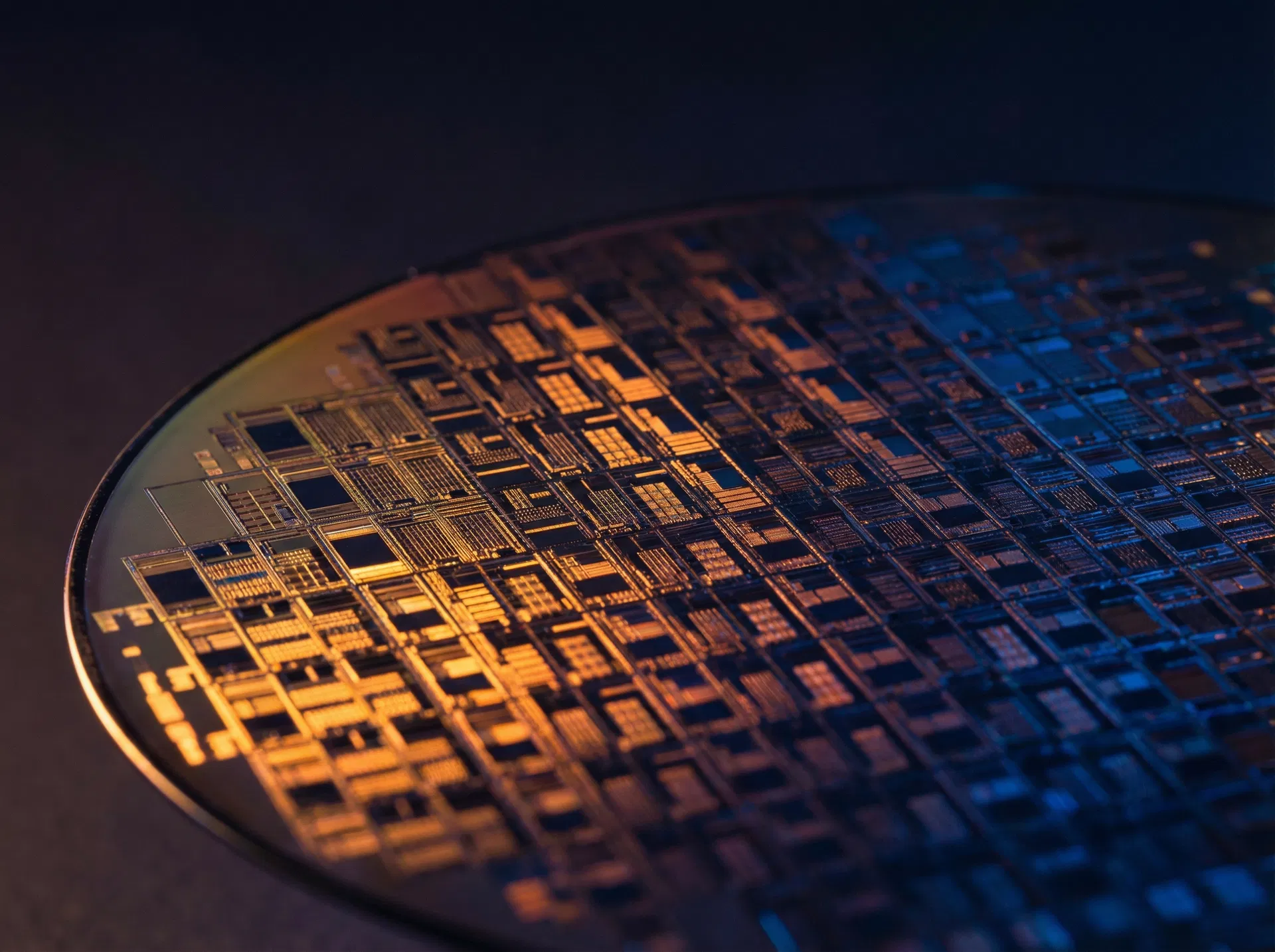
A semiconductor is a material — most commonly silicon — whose electrical conductivity falls between that of a conductor (like copper) and an insulator (like glass). By manipulating the electrical properties of silicon through a process called "doping," engineers can create transistors: tiny switches that can be turned on or off to represent the binary ones and zeros that underpin all digital computing. A modern semiconductor chip, or integrated circuit (IC), contains billions of these transistors etched onto a small piece of silicon called a "die," which is cut from a larger circular silicon wafer.
Market Size and Growth
The semiconductor industry has exhibited strong long-term growth, compounding at approximately 9 percent annually over the past decade. The market reached $630.5 billion in 2024, surpassing $600 billion for the first time. Gartner's broader measurement placed 2025 revenue at $793 billion, reflecting 21 percent year-over-year growth.
| Year | Global Revenue | YoY Growth | Key Driver |
|---|---|---|---|
| 2019 | $412B | +0% | Trade war headwinds |
| 2020 | $440B | +7% | Pandemic-driven PC/cloud demand |
| 2021 | $556B | +26% | Shortage-driven pricing, 5G ramp |
| 2022 | $574B | +3% | Memory downturn begins |
| 2023 | $527B | −8% | Inventory correction, memory trough |
| 2024 | $630B | +20% | AI demand surge, memory recovery |
| 2025E | $701B | +11% | Broadening AI, auto/industrial recovery |
Geographic Distribution
The semiconductor industry has a uniquely global structure. While the United States leads in chip design and EDA tools, manufacturing is heavily concentrated in Asia. Taiwan alone accounts for approximately 68 percent of global foundry revenue, with TSMC representing the vast majority. South Korea dominates memory production through Samsung and SK Hynix. China is the largest end market by consumption but remains dependent on foreign technology for advanced chips and equipment.
| Region | Design Share | Manufacturing Share | Key Players |
|---|---|---|---|
| United States | ~48% | ~12% | NVIDIA, Qualcomm, AMD, Intel, Broadcom |
| Taiwan | ~8% | ~68% (foundry) | TSMC, MediaTek, ASE Technology |
| South Korea | ~5% | ~18% (memory) | Samsung, SK Hynix |
| Europe | ~7% | ~8% | ASML, Infineon, NXP, STMicro |
| China | ~15% | ~10% | SMIC, HiSilicon (Huawei), CXMT |
| Japan | ~6% | ~13% | Renesas, Sony, Tokyo Electron |
The Semiconductor Value Chain
The modern semiconductor industry is organized into a highly specialized value chain, where different companies focus on distinct stages of the chip lifecycle. Understanding this structure is essential for evaluating investment opportunities.
1. EDA & IP — The Architects' Tools
Electronic Design Automation (EDA) companies provide the software tools that chip designers use to create, simulate, and verify integrated circuits. This is a duopoly controlled by Synopsys and Cadence, with Siemens EDA (formerly Mentor Graphics) as a distant third. EDA companies enjoy 80%+ gross margins, high recurring revenue, and deep competitive moats created by enormous switching costs.
Semiconductor IP companies license pre-designed circuit blocks. Arm Holdings dominates processor IP, with its architectures found in 99% of smartphones. Revenue is generated through upfront licensing fees and per-unit royalties.
2. Fabless Design — The Innovators
Fabless companies design chips but outsource all manufacturing to foundries. This model allows them to focus R&D spending on architecture and software rather than factory construction. The fabless model has produced some of the industry's most valuable companies: NVIDIA (AI GPUs), Qualcomm (mobile SoCs), AMD (CPUs/GPUs), Broadcom (networking), and Marvell (custom silicon).
3. Foundries — The Manufacturers
Pure-play foundries manufacture chips designed by fabless customers. TSMC is the undisputed leader, commanding approximately 65 percent of global foundry revenue and over 90 percent of leading-edge production (sub-7nm). Samsung Foundry is the only credible competitor at the leading edge, while GlobalFoundries, UMC, and SMIC serve mature nodes.
A single leading-edge fab costs $20–30 billion to build and equip. TSMC's capital expenditure alone exceeded $30 billion in 2024. This extreme capital intensity creates an almost insurmountable barrier to entry and explains why the foundry market has consolidated so dramatically.
4. Semiconductor Equipment — The Enablers
Equipment companies build the machines used to manufacture chips. The market is dominated by a handful of specialists, each with near-monopoly positions in their respective process steps:
| Company | Ticker | Specialty | Market Position |
|---|---|---|---|
| ASML | ASML | EUV & DUV Lithography | 100% monopoly in EUV |
| Applied Materials | AMAT | Deposition, Etch, CMP | Broadest portfolio |
| Lam Research | LRCX | Etch & Deposition | #1 in etch |
| KLA Corp | KLAC | Inspection & Metrology | #1 in process control |
| Tokyo Electron | 8035.T | Coater/Developer, Etch | #1 in coat/develop |
5. IDMs — The Verticals
Integrated Device Manufacturers (IDMs) design and manufacture their own chips. Intel is the most prominent IDM, though it is now also offering foundry services. Samsung operates as both an IDM (memory, displays) and a foundry. Texas Instruments is the world's largest analog semiconductor company, with over 80,000 products and its own fabs. Other notable IDMs include Infineon, STMicroelectronics, and Renesas.
6. Memory — The Commodity Cycle
Memory chips (DRAM and NAND flash) are the most cyclical segment of the semiconductor industry. The market is an oligopoly: Samsung, SK Hynix, and Micron control approximately 95 percent of DRAM and 90+ percent of NAND. Memory pricing is driven by supply-demand balance, with prices capable of swinging 50 percent or more in a single year.
7. OSAT — Assembly & Test
Outsourced Semiconductor Assembly and Test (OSAT) companies package and test finished chips. ASE Technology is the largest, followed by Amkor Technology. Advanced packaging — including chiplets, 2.5D/3D stacking, and fan-out wafer-level packaging — is becoming increasingly important as traditional transistor scaling slows.
Product Segments
Semiconductors can be classified by function into several major product categories, each with distinct growth drivers, competitive dynamics, and margin profiles.
| Segment | 2024 Revenue | Key Players | Growth Driver |
|---|---|---|---|
| Logic (Processors) | ~$200B | NVIDIA, Intel, AMD, Qualcomm | AI, data center, mobile |
| Memory (DRAM + NAND) | ~$180B | Samsung, SK Hynix, Micron | AI (HBM), cloud, mobile |
| Analog | ~$75B | TI, ADI, Infineon, STMicro | Auto, industrial, power mgmt |
| Discrete / Power | ~$45B | Infineon, ON Semi, STMicro | EVs, renewables, industrial |
| Optoelectronics | ~$45B | Sony, ams-OSRAM, II-VI | Image sensors, LiDAR, fiber |
| Sensors | ~$20B | TI, Bosch, STMicro, NXP | Auto, IoT, industrial |
Logic / Processors
The largest segment by revenue, encompassing CPUs, GPUs, FPGAs, and application-specific processors. NVIDIA's dominance in AI GPUs has made this the fastest-growing category, with data center GPU revenue alone exceeding $100 billion in 2025.
Memory
DRAM provides fast, volatile working memory for computing systems. NAND flash provides non-volatile storage. High Bandwidth Memory (HBM) has emerged as a critical component for AI accelerators, with SK Hynix holding the leading market position. HBM revenue is projected to exceed $100 billion by 2028, up from roughly $16 billion in 2023.
Analog
Analog chips convert real-world signals (temperature, pressure, light, sound) into digital data and vice versa. They are found in virtually every electronic system. The analog market is characterized by long product lifecycles (often 10+ years), high gross margins (60–70%), and less cyclicality than digital chips. Texas Instruments and Analog Devices are the dominant players.
End Markets
Understanding end-market exposure is critical for semiconductor investing, as different applications have vastly different growth rates, cyclicality, and margin profiles.
| End Market | Share of Revenue | Growth Outlook | Key Chips |
|---|---|---|---|
| Data Center / Cloud | ~30% | High (AI-driven) | GPUs, HBM, networking, custom ASICs |
| Smartphones | ~22% | Low single-digit | SoCs, modems, memory, RF, sensors |
| PCs | ~12% | Modest recovery | CPUs, GPUs, memory, SSDs |
| Automotive | ~12% | Mid-to-high single-digit | MCUs, power (SiC), sensors, ADAS |
| Industrial | ~12% | Mid single-digit | Analog, MCUs, power, sensors |
| Consumer Electronics | ~8% | Low single-digit | SoCs, memory, display drivers |
| Communications Infra | ~4% | Moderate (5G) | RF, networking, optical |
Data Center: The AI Supercycle
The data center has become the single most important end market, driven almost entirely by AI infrastructure buildout. Hyperscale cloud providers (Microsoft, Amazon, Google, Meta) are spending over $300 billion annually on capital expenditure, a significant portion of which goes to semiconductor content — GPUs, networking chips, memory, and storage.
Automotive: The Content Story
Semiconductor content per vehicle has risen from approximately $300 in a traditional ICE vehicle to $700+ in an EV and potentially $1,500+ in a fully autonomous vehicle. Key growth areas include silicon carbide (SiC) power devices for EV drivetrains, ADAS processors, and in-vehicle networking.
The Semiconductor Cycle
The semiconductor industry is one of the most cyclical in the global economy. Understanding the cycle is essential for timing investments and interpreting financial results.
The Two Overlapping Cycles
The Inventory Cycle (18–24 months): Driven by the bullwhip effect across a long supply chain. When end demand accelerates, each tier of the supply chain over-orders to build safety stock, amplifying demand signals. When demand slows, the reverse occurs — orders collapse as the supply chain destocks. This creates sharp, short-duration swings in semiconductor revenue.
The Capacity Cycle (4–6 years): Driven by the lag between investment decisions and new fab capacity coming online. It takes 2–3 years to build and qualify a new fabrication facility. When demand is strong, companies invest heavily in new capacity. By the time that capacity is operational, demand may have softened, leading to oversupply and price declines.
The semiconductor cycle has historically followed a pattern of 2–3 years of growth followed by 1–2 years of correction. However, the AI demand surge has introduced a structural element that may extend the current upcycle beyond historical norms — at least for AI-exposed segments.
Cycle Indicators to Monitor
| Indicator | Source | What It Signals |
|---|---|---|
| SIA Monthly Billings | Semiconductor Industry Association | Real-time revenue trends by region and product |
| SEMI Book-to-Bill | SEMI | Equipment order momentum; >1.0 = expansion |
| Memory Spot Prices | DRAMeXchange / TrendForce | Supply-demand balance in memory |
| Foundry Utilization | TSMC, UMC quarterly reports | Capacity tightness; pricing power |
| Channel Inventory (DOI) | Distributor earnings calls | Days of inventory; destocking vs. restocking |
| Capex Guidance | Major IDMs, foundries | Forward-looking capacity investment intentions |
Competitive Landscape
The semiconductor industry is characterized by extreme concentration at the top, with the largest companies commanding dominant positions in their respective segments.
Top 10 Semiconductor Companies by Revenue (2025)
| Rank | Company | Revenue | Segment | YoY Growth |
|---|---|---|---|---|
| 1 | NVIDIA | $125.7B | Fabless (AI GPU) | +114% |
| 2 | TSMC | ~$100B | Foundry | +34% |
| 3 | Samsung Semi | $72.5B | IDM (Memory) | +47% |
| 4 | SK Hynix | $60.6B | IDM (Memory) | +75% |
| 5 | Intel | $47.9B | IDM | −3% |
| 6 | Qualcomm | $37.0B | Fabless (Mobile) | +9% |
| 7 | Broadcom | $34.3B | Fabless (Networking) | +44% |
| 8 | AMD | $32.5B | Fabless (CPU/GPU) | +36% |
| 9 | ASML | ~$30B | Equipment (Litho) | +16% |
| 10 | Applied Materials | ~$28B | Equipment | +5% |
Business Model Comparison
| Model | Moat Source | Gross Margin | Cyclicality |
|---|---|---|---|
| EDA/IP | Switching costs, network effects | 80%+ | Low |
| Fabless (AI) | Architecture, software ecosystem | 60–75% | Moderate |
| Foundry (leading-edge) | Scale, process technology | 50–55% | Moderate |
| Equipment (monopoly) | IP, precision engineering | 45–55% | High |
| IDM (analog) | Product breadth, relationships | 60–70% | Moderate |
| Memory | Scale, process technology | 30–60% | Very High |
| OSAT | Scale, advanced packaging IP | 20–30% | High |
Key Trends & Structural Shifts
The AI Transformation
Artificial intelligence represents the most significant demand driver in the semiconductor industry's history. AI infrastructure spending is forecast to surpass $1.3 trillion in 2026. The AI semiconductor stack includes training accelerators (NVIDIA H100/B200, Google TPU, AMD MI300X), inference chips, high-bandwidth memory, networking (InfiniBand, Broadcom Tomahawk), and power management.
Geopolitical Reshoring & the CHIPS Act
The U.S. CHIPS and Science Act provides $52.7 billion in incentives for domestic manufacturing. Over 100 chip ecosystem projects have been announced across 28 states, representing more than half a trillion dollars in private investment. U.S. fab capacity is projected to triple by 2032. Similar initiatives are underway in Europe, Japan, South Korea, and India.
The Rise of Custom Silicon
Hyperscale cloud providers are increasingly designing their own chips: Amazon (Graviton CPUs, Trainium), Google (TPU), Microsoft (Maia, Cobalt), and Meta. This benefits EDA companies and foundries but threatens traditional merchant chip suppliers.
Advanced Packaging as a Differentiator
As traditional transistor scaling becomes more difficult, advanced packaging has emerged as an alternative path. Technologies like chiplets, 2.5D/3D stacking, and heterogeneous integration allow multiple specialized dies to be combined. TSMC's CoWoS technology has become a critical bottleneck for AI chip production.
Automotive Content Growth
Semiconductor content per vehicle continues to rise as cars become electrified, connected, and autonomous. EVs require significantly more power semiconductors (SiC, IGBTs) than ICE vehicles, while ADAS demands cameras, radar, lidar, and processing power.
Valuation & Financial Framework
| Metric | Fabless | Foundry | Memory | Equipment | EDA/IP | Analog |
|---|---|---|---|---|---|---|
| Gross Margin | 60–75% | 50–55% | 30–60% | 45–55% | 80%+ | 60–70% |
| R&D / Revenue | 15–25% | 8–12% | 8–12% | 12–18% | 30–35% | 10–15% |
| Capex / Revenue | 2–5% | 30–50% | 25–40% | 5–10% | 3–5% | 5–15% |
| Forward P/E | 20–35x | 15–25x | 8–15x | 15–25x | 30–50x | 18–28x |
| Cyclicality | Moderate | Moderate | Very High | High | Low | Moderate |
Fabless companies are best valued on forward P/E or EV/EBITDA, with adjustments for the growth rate of their end markets. Memory companies require through-cycle analysis because their earnings are extremely volatile — peak earnings should be discounted, and trough earnings should not be extrapolated. EDA/IP companies command premium valuations due to high recurring revenue and deep competitive moats, and are often valued similarly to enterprise software companies.
Foundries are valued on forward earnings adjusted for capital intensity. TSMC's premium reflects its technological leadership and strategic importance. Equipment companies are cyclical and should be evaluated with awareness of the equipment spending cycle. Analog IDMs are valued on their ability to generate consistent free cash flow through cycles.
How to Approach the Industry
The semiconductor industry rewards investors who combine structural understanding with cyclical awareness. Here is a systematic framework for approaching the space:
Understand Where You Are in the Cycle
Before making any semiconductor investment, determine the current position in both the capacity cycle and the inventory cycle. Are lead times extending or contracting? Are inventories building or depleting? Are memory prices rising or falling? The answers determine whether the sector is likely to see earnings upgrades or downgrades over the next 6 to 12 months.
Identify the Structural Growth Drivers
Separate cyclical demand from structural demand. AI infrastructure spending is currently the dominant structural growth driver, but automotive electrification, industrial automation, and the proliferation of connected devices also represent multi-year growth vectors. Companies with exposure to structural growth drivers will outperform through cycles.
Map the Value Chain Exposure
For any semiconductor investment, understand where the company sits in the value chain and what its upstream and downstream dependencies are. A fabless company depends on TSMC for manufacturing; an equipment company depends on foundry and memory capex budgets; an analog company depends on broad industrial and automotive demand.
Assess the Competitive Moat
The most durable semiconductor investments are in companies with strong competitive moats: ASML's monopoly in EUV lithography, Synopsys and Cadence's oligopoly in EDA, TSMC's manufacturing technology leadership, NVIDIA's CUDA software ecosystem, or Texas Instruments' breadth of analog products and manufacturing scale.
Evaluate the Financial Model
Understand the margin structure, capital intensity, and free cash flow generation of the business model. EDA companies generate abundant free cash flow with minimal capital requirements. Memory companies generate enormous free cash flow at cycle peaks but can burn cash at troughs. Foundries require massive ongoing capital investment.
Monitor the Leading Indicators
Stay current with monthly SIA billings data, SEMI equipment book-to-bill ratios, memory spot prices, foundry utilization rates, and the capital expenditure guidance of major players. These indicators often signal inflection points 3 to 6 months before they appear in earnings results.
Appendix: Key Companies at a Glance
| Company | Ticker | Segment | 2025 Rev | Description |
|---|---|---|---|---|
| NVIDIA | NVDA | Fabless | $125.7B | Dominant AI GPU supplier; CUDA ecosystem |
| TSMC | TSM | Foundry | ~$100B | World's largest foundry; 70% advanced node share |
| Samsung | 005930.KS | IDM | $72.5B | #1 memory, #2 foundry |
| SK Hynix | 000660.KS | IDM | $60.6B | #1 in HBM, #2 DRAM |
| Intel | INTC | IDM | $47.9B | Legacy CPU leader; building foundry business |
| Qualcomm | QCOM | Fabless | $37.0B | Dominant mobile SoC; expanding auto/IoT |
| Broadcom | AVGO | Fabless | $34.3B | Networking, custom AI ASICs |
| AMD | AMD | Fabless | $32.5B | CPUs, GPUs, FPGAs; #2 data center |
| ASML | ASML | Equipment | ~$30B | EUV lithography monopoly |
| Applied Materials | AMAT | Equipment | ~$28B | Broadest equipment portfolio |
| Texas Instruments | TXN | IDM | ~$16B | #1 analog; 80,000+ products |
| Lam Research | LRCX | Equipment | ~$17B | #1 etch equipment |
| KLA Corp | KLAC | Equipment | ~$11B | #1 inspection & metrology |
| Synopsys | SNPS | EDA/IP | ~$6.5B | #1 EDA; chip design software |
| Cadence | CDNS | EDA/IP | ~$5.5B | #2 EDA; verification & simulation |
| Arm Holdings | ARM | IP | ~$4B | Processor IP; 99% of mobile |
| NXP | NXPI | IDM | ~$12B | #1 auto semiconductors |
| Marvell | MRVL | Fabless | ~$7.5B | Custom AI silicon, networking |
| ASE Technology | ASX | OSAT | ~$20B | #1 outsourced assembly & test |
| Entegris | ENTG | Materials | ~$4B | Specialty materials, contamination control |
References
- [1] SIA. (2025). State of the U.S. Semiconductor Industry.
- [2] Gartner. (2026). Worldwide Semiconductor Revenue Grew 21% in 2025.
- [3] Deloitte. (2025). Semiconductor Industry Outlook.
- [4] McKinsey. (2024). Hiding in Plain Sight: The Underestimated Size of the Semiconductor Industry.
- [5] Oppenheimer. (2011). Semiconductor Industry Primer.
- [6] Wachovia. (2008). Semiconductor Industry Primer.
- [7] Generative Value. (2024). An Overview of the Semiconductor Industry.
- [8] Nomad Semi. (2025). State of the Semiconductor Cycle.
- [9] S&P Global. (2025). Semiconductor KPI Guide.